
Understanding Patient Data
(NHS Confederation)
Confident, evidence-led digital transformation through user-centred discovery
Project overview
Providing the evidence, insight and direction to shape a more accessible, trusted and user-centred digital experience.
Understanding Patient Data (UPD), part of the NHS Confederation, plays a critical role in helping the public, professionals and policymakers understand how health data is used.
With new long-term funding secured, UPD needed to make a key strategic decision: improve the existing website or invest in a full redesign.
Invuse was commissioned to deliver a comprehensive UX discovery, providing the data, insight and validated direction needed to move forward with confidence.
The challenges
A thorough discovery phase with users and stakeholders identified key barriers to understanding, navigation and self-service.
1. Users struggled to complete key tasks
-
Only 57% task success rate, well below the 70% benchmark for a usable digital service
-
Some journeys as low as 33% success
-
Users unable to complete tasks without multiple attempts
-
Key actions not clearly signposted or easy to follow
2. Journeys were unclear and inefficient
-
Only 41% directness across journeys
-
Users frequently looped between pages
-
Multiple entry points for the same information
-
Lack of clear next steps within journeys
3. Finding information took too long
- Average task completion time of 9 minutes 29 seconds, significantly higher than expected for information-based journeys
-
Even simple journeys slowed by navigation issues
- Users spent time exploring rather than completing
-
High effort increased frustration and drop-off
4. Content and structure did not match user needs
-
Topics split across multiple sections
-
Inconsistent terminology across the site
-
Content structured around organisational needs rather than user intent
-
No clear pathways for different audience types
Designing services around user needs
Combining qualitative depth with structured testing allowed us to understand not just what users were doing, but why they were struggling.
1. Research with real users and stakeholders
101+ participants across public, professional and policy audiences
Stakeholder interviews and internal workshops
Public workshop with diverse NHS data personas
Online survey to capture broader audience insight
2. Task-based usability testing and benchmarking
25 usability interviews across key user groups
Measured task success, time and journey efficiency
Tested real-world scenarios aligned to user needs
Established a clear performance baseline
3. Information architecture tested and validated
Tree testing used to validate navigation structure
Identified where users expected content to be
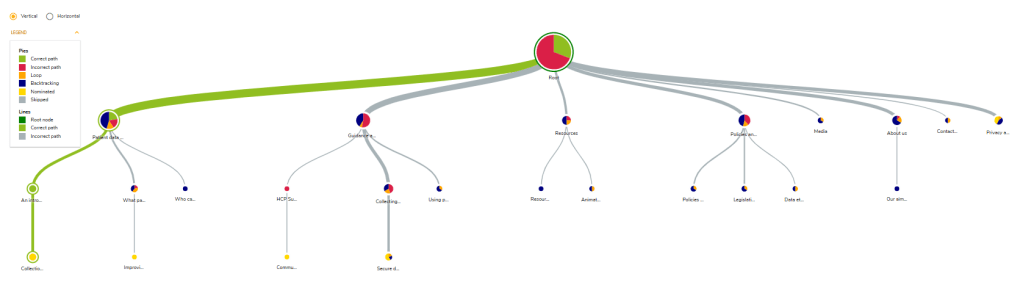
Highlighted areas causing confusion and backtracking
Ensured structure aligns with user mental models
4. Information architecture tested and validated
-
Tree testing used to validate navigation structure
-
Identified where users expected content to be
-
Highlighted areas causing confusion and backtracking
-
Ensured structure aligns with user mental models
Key insights from users
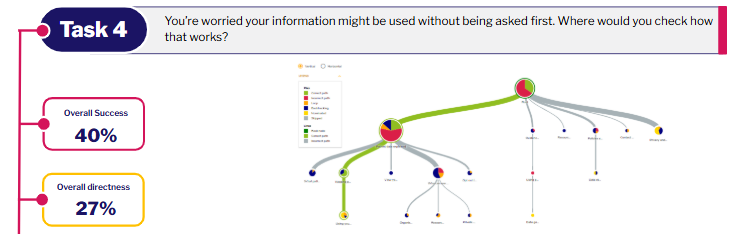
Conducting tree tests with members of the public allowed us to assess how well the proposed structure supports user navigation
- Users struggled to interpret complex health data without clear context or plain English explanations
- Navigation and content structure did not reflect how different audiences approach the topic
- Trust was impacted where transparency and intent were not clearly communicated
- Users required clearer pathways to relevant resources based on their role or interest


From insight to direction
The discovery translated complex research into clear, prioritised actions, ensuring stakeholders could move forward with confidence and a shared understanding of what to improve and why.
1. Clear evidence to support decision-making
Identified 14 key usability issues and improvement opportunities across priority journeys
Identified priority areas for improvement
Provided a data-driven foundation for investment decisions
Reduced risk in future design and development
2. Defined priority user journeys and needs
Identified the most important tasks across audiences
Mapped pain points and barriers in each journey
Highlighted where users drop off or struggle
Aligned stakeholders around shared priorities
3. Validated structure and content direction
Recommended simplified, user-led navigation
Defined clearer content groupings and pathways
Introduced consistent content design patterns
Improved alignment with user expectations
4. Concept designs to demonstrate future experience
Developed prototype concepts based on research
Showed how journeys could be simplified
Demonstrated improved navigation and clarity
Provided a clear vision for the next phase
The outcome
A clear, evidence-based foundation to move forward with confidence and deliver meaningful digital transformation
- Clarity and confidence in next steps: The discovery process produced a clear, evidence-based recommendation for redesign — giving stakeholders a defined scope, reducing uncertainty, and providing the confidence needed to move forward.
- Alignment across stakeholders: By grounding decisions in user research, the project created genuine alignment across teams — a shared understanding of resident needs, agreed priorities, and a solid foundation for delivery.
- A user-centred roadmap for transformation: The outcome was a prioritised, sequenced roadmap with defined success measures and KPIs — a clear, scalable path from current state to improved resident experience.
- Continuation into delivery: Invuse has been selected to deliver the next phase — bringing discovery insights into iterative design and Drupal development, with continuous user testing and exploration of intelligent automation and AI to further support self-service.
Why this matters for health organisations
Organisations working across health and data must balance complexity with clarity. This discovery highlights the key principles required to deliver trusted, accessible digital services at scale:


Clarity drives trust

Design for diverse audiences

Reduce effort, improve access
This project demonstrates how a structured discovery can:
- Identify real user needs
- Quantify performance issues
- Provide a clear, evidence-based direction
- De-risk digital transformation investment
The discovery has established a clear, evidence-led foundation for transformation. Invuse is now working with Understanding Patient Data to deliver iterative improvements through user-centred design, Drupal development and the responsible use of AI and automation, ensuring the service continues to evolve in line with user needs.
Find out more about our digital transformation projects with the Public Sector: